

This post contains affiliate links. View the disclosure for more information
Feeling lost rarely looks like a breakdown. Most of the time, it looks like a very busy Tuesday.
You’re not falling apart. Nothing is technically wrong. You’re managing — probably managing really well. But underneath all of it, there’s a quiet pull, like something important keeps getting skipped over. Like you’ve been running your own life for everyone else so long, you genuinely can’t remember how to find yourself in it anymore.
I know this feeling personally. I spent years fully functional, fully capable, and quietly disappearing at the same time. What I didn’t understand then is what I want you to hear right now: you don’t have to hit rock bottom to have lost yourself. Sometimes all it takes is years of putting everyone else first.
This post is about recognizing what that loss actually looks like, why it happens to women who are doing everything right, and what it takes to find yourself again — starting today.
8 Signs You’ve Lost Yourself
Most people expect it to feel dramatic. A crisis moment. An obvious sign that something broke.
For most women, it’s quieter than that. It’s a slow drift — one accommodation, one postponed want, one more year of putting yourself last. By the time you start asking how to find yourself, you’ve usually been lost for a while. You just didn’t have a name for it.
- You don’t know what you enjoy anymore — outside of what you do for others.
Someone asks what you’re into, and your mind goes blank. Not because you’re shy. Because you can’t remember the last time you did something just for you — no productivity angle, no one else to take care of, no reason other than you wanted to.
- You say yes when you mean no — and you’ve stopped noticing the difference.
It’s become automatic. “Yes” is your default. Not because you want it, but because you forgot there was another option along the way.
- You’ve become the version of yourself that’s easiest for everyone else to deal with.
Agreeable. Uncomplicated. Low-maintenance. These got treated like compliments for so long that you started to believe they were.
- You feel more like a function than a person.
Mother. Partner. Employee. Friend. These roles are real. They matter. But the person underneath them feels blurry — like she got quietly edited out somewhere between last year and the year before. If this one hits, these micro-habits for women done feeling behind are a good starting point for getting her back.
- Your opinions feel borrowed.
From your circle. From social media. When you sit in actual quiet, you’re not sure what you actually think. That’s one of the clearest signs you’ve lost the thread of yourself.
- Rest has to be earned.
You need to be tired enough, useful enough, done enough before you allow yourself to stop. Taking care of yourself feels like something you have to justify — and that alone tells you something important about how far you’ve drifted. If you want somewhere to start reclaiming it, these self-care ideas don’t require a reason or a perfect moment.
- You can’t remember the last time you did something just because you wanted to.
A meal. A show. An afternoon. A purchase that was only ever yours. Something with zero utility and zero audience.
- Your relationship with yourself has gone quiet.
Not hostile. Just distant. Like a friendship you’ve let drift — and the longer you leave it, the harder it feels to start.
Recognizing these signs is the real starting point. You cannot know how to find yourself again until you can name exactly what got lost.
Why This Happens (And Why It’s Not a Failure)
Losing yourself isn’t a weakness. It’s what happens when a woman prioritizes her usefulness over her identity for long enough.
It starts small. You adjust here, accommodate there, and postpone something that feels important until things settle. Then one day the settling never comes, and you can’t even remember what you were waiting to reclaim.
Research on identity and self-concept shows that a sense of self requires consistent attention — it doesn’t maintain itself automatically. The women who lose themselves this way are often the most capable ones. So skilled at managing everything else that the inner work gets indefinitely deferred.
That’s also what makes it hard to spot. Nothing is technically wrong. You’re not failing anyone. You’re just not quite there.
This is the part that matters: how to find yourself again doesn’t start with a reinvention. It starts with honesty about where you actually are.
How to Find Yourself Again
Before we get practical — you’re not starting from zero. Finding yourself again isn’t about becoming someone new. It’s about getting honest about where you’ve been, so you can decide who you’re becoming.
Start with honest questions.
Honest questions are the real starting point for finding yourself again. Not a new planner. Not a vision board. Five minutes of real journaling — with a pen and paper, not a notes app — with these three:
What do I actually want right now, not eventually? Where am I living for someone else’s approval? What have I quietly given up that I’d like back?
Write the true answer, not the good one. That’s how you find yourself — one honest line at a time.
If you want a journal that holds up to that kind of writing, this guided self-discovery journal is one I’ve recommended before. It’s not fluffy. The prompts go somewhere.
Let go of who you’ve been performing.
Part of how to find yourself again means retiring the version of you who’s always available, never difficult, endlessly patient — she’s not a lie, but she’s not the whole story. You’re allowed to have edges. Opinions that inconvenience people. Needs that don’t fit neatly into everyone else’s plans.
One place to start is building a simple night routine that carves out even one hour that belongs entirely to you. Not productive time. Not family time. Yours.
Create space to come back to yourself.
This sounds abstract until you do it. A bath with good products instead of the quick shower you always take. A slow morning. A corner of your home that feels like you made it for you.
A few things that have helped me create that space:
A quality aromatherapy diffuser — the kind of thing you buy for the house but is really for yourself. Certain scents signal to your body that the workday is done and this hour belongs to you.

A soft plush throw blanket for the chair or corner that’s yours. Small, specific, intentional. When you sit there, you’re not on. It sounds insignificant. It compounds.

These aren’t luxuries. They’re anchors. Small physical things that remind your body: this is mine.

Build your healing space at home
Take one small, true action.
This is how to find yourself again in practice, not one reinvention. A class you take for no reason. An hour you protect without explaining yourself. A boundary you hold even when it’s uncomfortable.
The women who figure out how to find themselves again don’t do it through a grand gesture. They do it through one consistent choice — to take themselves seriously — made over and over until it becomes who they are.
Ready to Go Deeper Than a Blog Post?
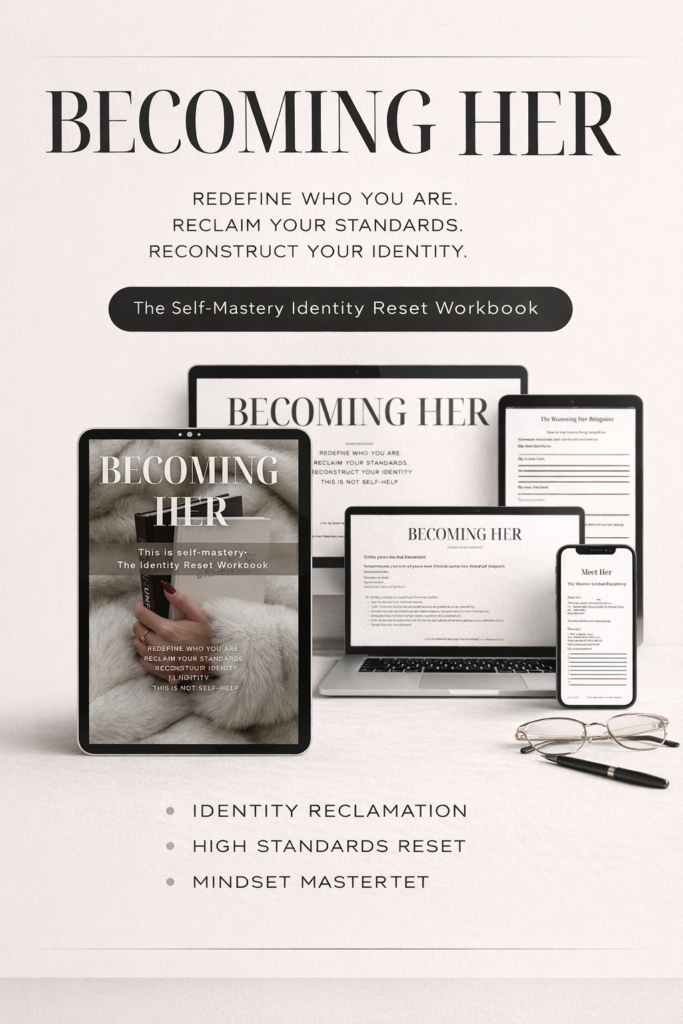
The Becoming Her: The Identity Reset Workbook is the next step after this post. It’s a guided process for the woman who is done drifting and ready to get honest about who she’s been and who she’s choosing to become.
Not affirmations. Not generic prompts. A real identity reset, step by step.
This is what helped me go from asking how to find myself to actually doing it.
Your Starting Point
How to find yourself again doesn’t happen in a weekend. It happens in the quiet, consistent choice to take yourself seriously — starting with one honest look at where you actually are right now.
That’s what the Becoming Her Self Assessment is for. 15 questions. A clear picture. Your real starting point — the true one, not the impressive one.
Read Next











Add comment