

This post contains affiliate links. View the disclosure for more information
She didn’t find herself. She built herself — one belief, one habit, one decision at a time. And her brain made it permanent.
Here’s the thing nobody tells you about becoming a better version of yourself: it’s not a mystery. It’s not luck. It’s not reserved for women who had the right upbringing, the right opportunities, or the right amount of confidence handed to them at birth.
It’s neuroscience. And understanding it changes everything.
I spent years thinking that who I was had already been decided — that my patterns, my fears, my automatic responses were just me. What I didn’t know was that every single one of those patterns was a neural pathway. Grooved in by repetition. And every neural pathway that gets grooved in can be replaced by a new one. That’s not motivation. That’s biology.
Here’s what science actually says about becoming a better version of yourself — and why your brain is already fully capable of the transformation you’ve been circling.
Can you really become a better version of yourself — at any age, from any starting point?
Yes — and the science is unambiguous. Emerging research in cognitive neuroscience confirms that the self is not found — it is built. Your brain is not a fixed monument. Your identity is a fluid, ever-evolving network of neural connections that is being actively rewritten every single day.
Your memories, beliefs, values, and experiences are the highways that connect neurons and define who you are. Which means who you are right now is not a ceiling. It’s a starting point.
Becoming a better version of yourself isn’t a personality question. It’s a neurology question — and neurology has very good news for you.
Why Your Brain Is Keeping You Stuck in the Old Version of You
This is the part most self-help content skips — and it’s the most important thing to understand. Your brain isn’t resisting change because you’re weak. It’s resisting because it’s efficient. The neural pathways you’ve used for years are well-worn, fast, and energy-efficient. New ones feel hard because they are hard — at first.
Every uncomfortable new habit, every unfamiliar belief, every time you choose differently than you always have — that is literally the physical process of building new neural architecture.
The amygdala — your brain’s emotional processing center — plays a critical role here. Fear, anxiety, excitement, and even grief can surge as you begin to shed old patterns. That turbulence isn’t a sign you’re doing it wrong. It’s a sign your brain is actively restructuring.
The old version of you will feel safer for a while. That’s neuroscience — not failure.
While you’re here: 9 Signs You’re Living Someone Else’s Life — And How to Reclaim Your Own
How the Brain Actually Builds a Better Version of You
Your Attention Decides What Gets Built
Attention is the brain’s filtering mechanism — what passes through that filter is what gets encoded. What you consistently focus on, return to, and invest mental energy in becomes what your brain builds infrastructure around. Becoming a better version of yourself starts not with what you do, but with what you consistently choose to pay attention to.
If you return to the belief that you are capable, creative, and evolving — your brain encodes that as reality. If you return to the belief that you are behind, unworthy, or stuck — that gets encoded too. You are always building something. The only question is whether you’re building it intentionally.
Your Emotions Determine What Gets Remembered
Emotionally charged experiences are prioritized during memory encoding and retrieved more readily — researchers call this emotional memory enhancement. This works both ways. The failures that embarrassed you got encoded deeply. But so does every win, every moment of pride, every time you showed up for yourself when it was hard.
This is why celebrating little progress isn’t indulgent when you’re working on becoming a better version of yourself — it’s a neurological strategy. Teaching your brain that growth feels good is one of the most powerful tools you have. That proof compounds.
Your Beliefs Literally Rewire Your Physiology
Belief activates predictive networks that shape perception, emotion, and physiology — turning thought into biology. The woman you believe you are becoming changes the neural predictions your brain makes about what’s possible for you. When identity shifts, everything changes: biology, behaviour, beliefs, and the world around you.
You don’t wait until you’ve become her to believe it. You believe it first — and your brain starts building toward it immediately. That is the most powerful truth about becoming a better version of yourself that most women never fully claim.
Repetition Makes the New Identity Automatic
Every time you act in alignment with who you’re becoming — even in tiny ways — you strengthen the new neural pathway. Every time you choose the thought, the habit, the response of the woman you’re designing yourself to be, that pathway gets faster, more automatic, more you.
The more connected you feel to your future self, the wiser your present-day decisions become. Becoming a better version of yourself is not a one-time decision. It’s a daily practice of choosing — and then choosing again.
The Becoming Her workbook turns the neuroscience of becoming a better version of yourself into practical, guided identity work — giving your brain the clear, specific input it needs to start building in the right direction.
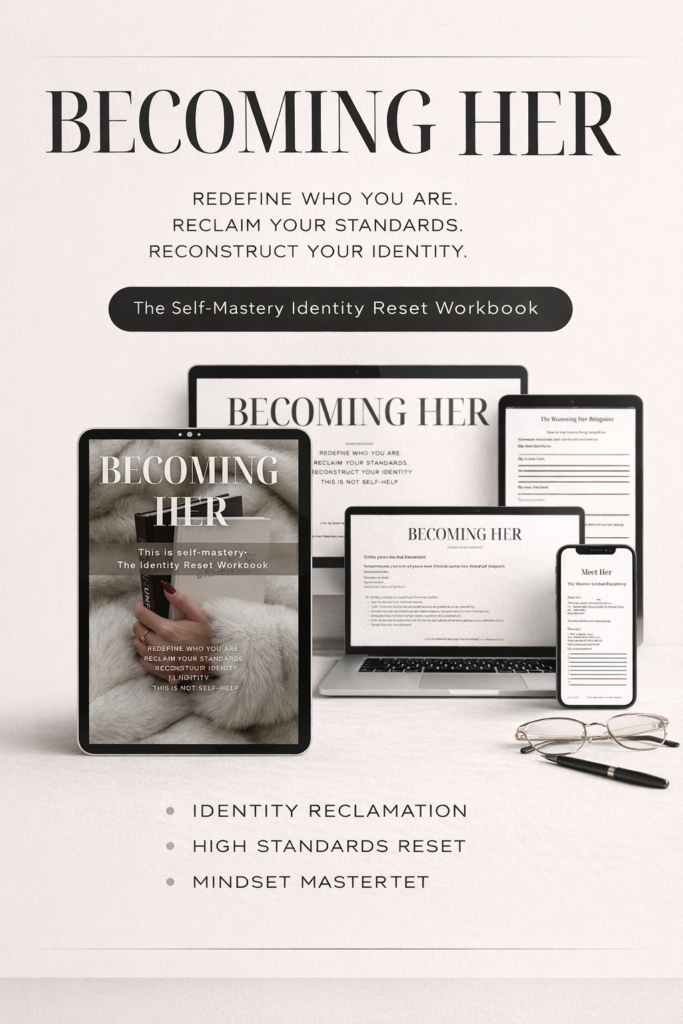
Change your identity, change your biology. The Becoming Her Workbook delivers the precise daily framework to rewire your brain from the inside out.
The Practical Side — What This Means for How You Live
Becoming a better version of yourself isn’t just a fascinating concept. It’s actionable. Here’s what neuroscience means in your daily life:
The stories you tell about yourself are not just words. Every time you say “I’m not someone who…” you’re reinforcing a neural pathway that makes that true. Every time you say “I’m becoming someone who…” you’re laying new architecture. Language is not soft — it’s structural. Choose it deliberately.
Your environment shapes your brain more than willpower does. The people you spend time with, the content you consume, the spaces you inhabit — all of it is input your brain is processing and building from. Curating your environment is one of the highest-leverage strategies for becoming a better version of yourself. It’s not superficial. It’s scientific.
Your habits are the physical expression of your identity. Every habit you build is your brain making an automatic decision — removing it from effortful choice and embedding it in who you are. Build the habits of the woman you’re becoming, and your brain will make her the default.
Continue the journey: 13 Micro-Habits for Women Who Are Done Feeling Behind
Common Mistakes Women Make When Trying to Change
Waiting to feel ready before acting differently. Readiness is a feeling — and feelings follow action, not the other way around. Act like the better version of yourself first, and the feelings catch up. The brain doesn’t wait for confidence before building new pathways — it builds confidence by building new pathways.
Trying to change everything at once. The brain builds one pathway at a time. Overwhelming it with simultaneous overhauls activates the threat response and sends you straight back to old patterns. One shift at a time. Deeply, consistently, until it’s automatic. That’s how becoming a better version of yourself actually happens.
Treating setbacks as evidence that you haven’t changed. A single day of old patterns doesn’t erase the neural work you’ve done. The brain builds cumulatively. A setback is not demolition — it’s one day in a long construction project that is still very much underway.
Becoming a better version of yourself happens fastest when your brain has a specific, vivid direction to build toward — and the Vision Planning Workbook is where you create that direction with enough clarity to make it real.

Your brain can’t build what it can’t see. The Vision Planning Workbook delivers the exact clarity needed to trigger real, neurological transformation.
You Were Always Capable of This
The woman you’re becoming isn’t a stranger to your brain. She’s the version of you that gets built when you give your brain consistent, intentional, emotionally resonant input over time. She’s what happens when you stop accidentally rehearsing the old version and start deliberately practicing the new one.
Becoming a better version of yourself is the most empowering thing neuroscience has to say about human identity — because it means transformation is not a matter of luck, personality, or privilege. It’s a matter of neurology. And neurology responds to practice.
Your brain is listening to everything you tell it. Tell it the truth about who you’re becoming — and give it the consistent input to make that woman real.
Go deeper here: Design your Dream Life — Before Life Designs It For You
You are not stuck. You are mid-construction. Keep going.












Add comment