

This post contains affiliate links. View the disclosure for more information
Nobody tells you that self-discipline for women has been taught completely wrong.
We were handed someone else’s version. Wake up at 5 am—cold showers. Say no to everything. Push through. And when we couldn’t sustain it — because no one can sustain it over the long term — we assumed something was wrong with us, not with the approach.
I’ve been there. Years of starting strong and falling apart by Thursday. I thought I lacked willpower. I didn’t. I was using the wrong kind of discipline entirely.
Here’s what I know now: self-discipline for women isn’t about force. It’s about identity. When you decide who you are, following through stops feeling like a battle and starts feeling like the obvious thing.
This is how you build it the soft way.
Why Self-Discipline Feels So Hard in the First Place
The traditional model of self-discipline is built on restriction and resistance. White-knuckling. Saying no. Forcing yourself. That model works for a while, then collapses — because it’s running on a depleting resource.
Research on habit formation consistently shows that people who appear to have strong self-discipline don’t actually rely on willpower. They’ve structured their environment and identity so that the right action requires the least resistance. Self-discipline isn’t something they draw on. It’s something they’ve built into the architecture of their days.
The problem isn’t that you lack discipline. The problem is that you’ve been trying to discipline yourself into someone you don’t fully believe you are yet.
That’s the real reason self-discipline for women feels so hard. You’re fighting your own self-image every single day.
9 Ways to Build Self-Discipline the Soft Way
1. Decide who you are before you decide what you’ll do
Self-discipline for women starts with identity, not action. Before you set a habit, ask who you are becoming. Not who you want to be someday — who you are deciding to be now.
“I am a woman who moves her body every day” lands differently than “I need to work out more.” One is a decision. The other is a wish. The discipline follows the decision automatically, because your actions start to confirm the identity instead of fighting it.
2. Make one decision that makes ten decisions for you
Willpower runs out. Decisions made in advance don’t. Self-discipline for women becomes dramatically easier when you stop making the same decision every day and instead make a standing choice that removes the moment of debate entirely.
If you decide on Sunday that weekday mornings include thirty minutes of quiet work before anything else, you don’t decide that again on Monday. The decision is already made. That single rule handles ten days’ worth of moments where willpower would have failed you.
3. Protect your mornings by protecting your nights
You cannot build self-discipline for women on an empty tank. A simple night routine — even twenty minutes — changes your morning completely. What you do at night determines what you’re capable of in the morning. The discipline to wake up early, to focus, to follow through — it all draws from the same energy reserve, and that reserve is filled at night, not in the morning.
An hour before bed, phones down. Ten minutes of prep for tomorrow. That’s it. That’s the foundation most people are missing.
4. Make the right thing easy, not heroic
The women with strong self-discipline didn’t get stronger willpower — they got better systems. They put the running shoes by the door. They meal-prepped on Sunday. They deleted the apps that wasted their evenings.
Self-discipline for women isn’t about conquering temptation every time. It’s about reducing the number of times temptation shows up. Design your environment so the choice you want to make is the path of least resistance, not the harder one.
5. Build identity proof, not just streaks
Streaks are fragile. Identity is not. Every time you follow through — even on something small — you cast a vote for who you are. One vote doesn’t win an election, but a thousand votes do.
The goal of self-discipline isn’t a perfect record. It’s a pattern that builds evidence. Evidence that you are the woman who shows up. Evidence that you follow through. Evidence that you can be trusted by yourself.
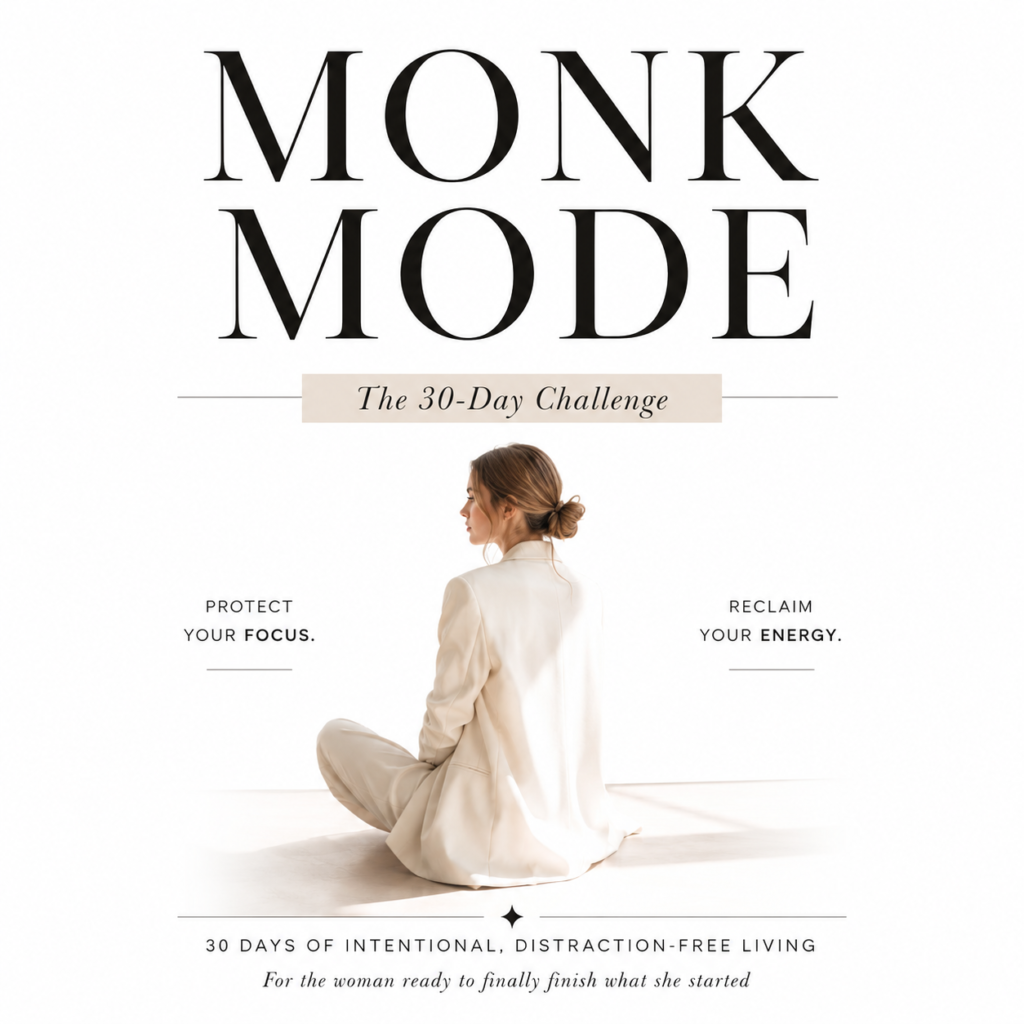
If you want a structure that removes the guesswork entirely, I built the Monk Mode 30 Day Challenge for exactly this. Thirty days. One clear framework. No motivation required — just decisions made in advance.
6. Lower the floor, not the ceiling
When motivation is low, most women abandon the plan entirely. The all-or-nothing trap. The soft version of self-discipline for women says: lower the floor, never skip twice.
Your full workout is forty-five minutes. Today the floor is ten. You show up for ten minutes. That’s it. You didn’t skip. You still cast the vote. And most of the time, ten minutes becomes thirty because starting was the only obstacle.
The daily habits of women who seem to have it together aren’t usually dramatic. They’re small, non-negotiable floors that they never go below — even on the hardest days.
7. Read the women who figured this out before you
Self-discipline for women isn’t a new problem. Some of the clearest thinking on it is already written. The books that rewired how I think about discipline:


You don’t have to figure this out alone. You stand on the shoulders of women — and researchers — who already mapped this terrain.
8. Stop breaking promises to yourself casually
Every time you say you’ll do something and don’t, your brain logs it. Not dramatically. Quietly. And over time, you become someone who doesn’t trust herself. Self-discipline for women is built on a foundation of kept promises — especially the private ones no one else will see.
Start small. Promise yourself one thing today. Keep it. Then another. The relationship between you and yourself is the most important relationship you will ever manage, and it runs on the same currency all relationships do: reliability.
9. Use a weekly reset to realign
Self-discipline isn’t a constant state — it’s a rhythm. Women who sustain it long-term don’t maintain perfect discipline every single day. They have a Sunday reset that brings them back when they’ve drifted.
Every Sunday, a short review. What worked. What didn’t? What needs to change? Not a guilt session — a recalibration. That one habit, done consistently, does more for your long-term self-discipline than any morning routine ever will.
The woman you’re becoming doesn’t have unlimited willpower. She has a clear identity, a simple structure, and a habit of coming back when she gets off track. That’s the whole thing. Self-discipline for women isn’t a sprint — it’s a return.
Which of these is the one you need most right now? Leave it in the comments — I read every one. ↓
Read next:











Add comment