

This post contains affiliate links. View the disclosure for more information
You don’t have a focus problem. You have a direction problem — and monk mode is how you fix it.
There was a point in my life where I was doing everything and getting nowhere. My phone never left my hand, my to-do list kept growing, and my actual goals — the ones that really mattered — kept getting pushed to tomorrow.
I wasn’t lazy. I wasn’t incapable. I was just completely without direction, buried under the weight of constant distraction. Then I found monk mode, and something finally clicked.
Monk mode isn’t about becoming someone else. It’s about finally becoming who you’ve been trying to be all along.
Why does distraction feel so impossible to escape — and what actually works?
Because willpower alone was never the answer. Monk mode is. Let’s get into it.
What Is Monk Mode?
Monk mode is a personal development practice where you intentionally eliminate distractions, reduce social consumption, and redirect your energy entirely toward your goals. Think of it as going offline from everything that doesn’t serve your growth — and fully online to your purpose.
The concept has roots in ancient monastic traditions, where Buddhist and Christian monks stripped life down to its essentials — prayer, discipline, deep work, and reflection. Modern high achievers have borrowed this framework and applied it to career, health, creativity, and personal growth.
Monk mode isn’t a rigid system or an extreme lifestyle overhaul. It’s a mindset shift — one that trades scattered energy for intentional direction, one day at a time.
What Monk Mode Actually Does For You
This is where most people get it wrong. They think monk mode is about restriction — giving things up, going quiet, disappearing. But the real transformation is what rushes in when the noise clears out.
When you practice monk mode, you stop reacting to everything around you and start creating with intention. Your brain gets space to think clearly. Your goals stop feeling overwhelming and start feeling reachable. The work that used to feel impossible starts to flow — because for the first time in a long time, nothing is pulling you in ten directions at once.
Distraction keeps you busy. Monk mode gives you direction. And direction is what actually builds a life.
For a deeper look at the science behind why this works, Cal Newport’s book on Deep Work is one of the most compelling cases for why monk mode produces the results it does.
The 9 Core Monk Mode Rules to Know
There are no rules written in stone, but these principles are the foundation of the practice.
1. Eliminate distractions ruthlessly
Most distractions don’t announce themselves — they creep in through cluttered environments, background noise, and commitments that never should have made your plate in the first place.
During monk mode, you do a full audit of everything stealing your attention and cut it without guilt. You’re not being antisocial — you’re being intentional. There’s a difference, and monk mode teaches you to own it.
2. Set crystal-clear goals
Monk mode without a target is just isolation. Before you begin, get specific about what you’re working toward. The clearer the goal, the sharper the direction.
3. Build a non-negotiable daily structure
A consistent routine is what separates monk mode from a productivity spiral. Wake at the same time, work in focused blocks, and protect your mornings and evenings like they’re sacred.
4. Prioritize deep, uninterrupted work
Monk mode is built for depth, not busyness. Shallow tasks take a back seat. Your most important work gets your best, most focused hours — every single day.
5. Protect your physical and mental health
This is non-negotiable. Monk mode isn’t about burning yourself into the ground — it’s about performing at your absolute peak. Sleep, movement, nutrition, and genuine rest are part of the practice, not sacrifices to it.
The mind and body connection runs deeper than most people realize — this post on 9 Ways to Shape Up from Within: Mind Body Control is worth reading alongside your monk mode practice.
6. Limit social and digital consumption
That includes news, gossip, social media, and environments that drain your energy. You don’t disappear from the world entirely — you just stop letting the world dictate your direction.
7. Reflect and recalibrate consistently
Daily journaling, meditation, or quiet walks create space to process your progress and come back to your why. Monk mode without reflection is just hustle wearing a different name.
8. Minimize decision fatigue
Simplify your meals, your wardrobe, your schedule — anything that consumes mental energy without contributing to your goals. Save your sharpest thinking for your most meaningful work.
9. Stay committed to the full process
Monk mode isn’t a weekend experiment. The real results show up when you stay consistent. Give it at least 30 days before you judge what it can actually do for you.
How to Turn Distraction Into Direction — Starting Today
You don’t need a dramatic life overhaul to begin. Here’s how to step into monk mode with real intention.
Start by setting up a distraction-free workspace — a dedicated room, a quiet corner of your home, a café that puts you in flow. Your environment is either working for your focus or against it. There is no neutral.
Next, define your monk mode season. A week, a month, thirty days? Give yourself a clear container so you’re working with direction — not just grinding with no finish line in sight.
Then address your phone. Delete the apps that steal time, silence notifications, and set specific windows for checking messages. Every notification that interrupts you is a small redirection away from what actually matters.
If you want a complete structure that maps it all out for you, try Monk Mode, the 30-day challenge.
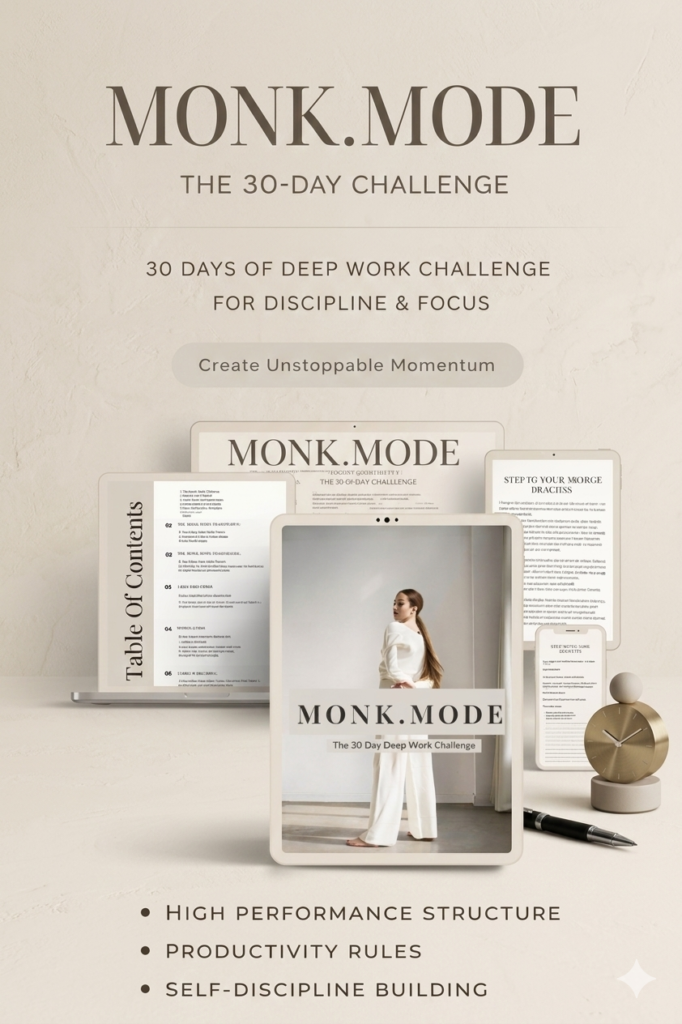
The Monk Mode 30-Day Challenge gives you daily prompts, accountability check-ins, and a clear roadmap to follow for a full month of focused, intentional living. It takes the guesswork completely out of getting started and puts direction back in your hands.
Successful People Who Practice Monk Mode
You’ve probably admired the results of monk mode without knowing what was behind them. Some of the most driven people in the world — women and men — have built this practice into the foundation of how they operate.
Maya Angelou — One of the most celebrated writers of the 20th century, Angelou rented a bare hotel room in every city she lived in — no artwork, no decorations, nothing to pull her attention away. She arrived at six-thirty every morning and wrote until the afternoon, completely alone, completely focused. That stripped-down discipline is how she produced some of the most powerful literature the world has ever read.
Oprah Winfrey — the first Black female billionaire, didn’t build her empire by staying available to everyone all the time. Oprah has practiced daily meditation for decades, carving out twenty minutes of intentional silence every single morning to clear her mind and anchor her focus before she steps into the demands of her day. She’s spoken openly about how that stillness is the foundation of everything she creates.
Serena Williams — the greatest tennis player of all time, didn’t get there on talent alone. During training season, Serena protected her mornings with an intensity most people can’t match. Four hours on the court every morning, completely off-limits to everyone around her. Her own words say it plainly: “Morning time is tennis time.” That boundary — held consistently, without exception — is monk mode in its purest form.
Across industries and arenas, some of the world’s most driven men have practiced the same philosophy.
Elon Musk — known for his intense, uninterrupted focus as he built multiple companies simultaneously, often working in complete isolation from distraction.
Tim Ferriss — the author and entrepreneur, regularly goes fully offline to remove all distractions and pour himself into one creative project at a time.
Kobe Bryant — the late basketball legend, was famous for disappearing into complete isolation during training season, living solely and entirely for his craft.
Ray Dalio — meditation, mindfulness, and structured silence have been central to how he runs one of the most successful hedge funds in the world.
None of them stumbled into success. They chose direction over distraction, over and over again — and they built monk mode seasons into their lives deliberately because of it. The common thread? They knew exactly who they were and what they were building toward.
If that kind of self-defined, focused living resonates with you, this is worth reading next: What Independent Women Want — And The 18 Traits That Make Them Unstoppable
Is Monk Mode Right for You?
Monk mode is powerful — but it isn’t one-size-fits-all. If you’re prone to over-isolation, burnout, or have responsibilities that require your active presence, the key is to build a version of monk mode that actually fits your life.
Even a partial practice — protecting your mornings, reducing social media, and committing to two to three hours of deep, uninterrupted work — can create a noticeable and lasting shift in the direction your life is moving.
If rebuilding your focus from the ground up feels more like where you are right now, Get Your Life Back: The Focus Reset is the place to start
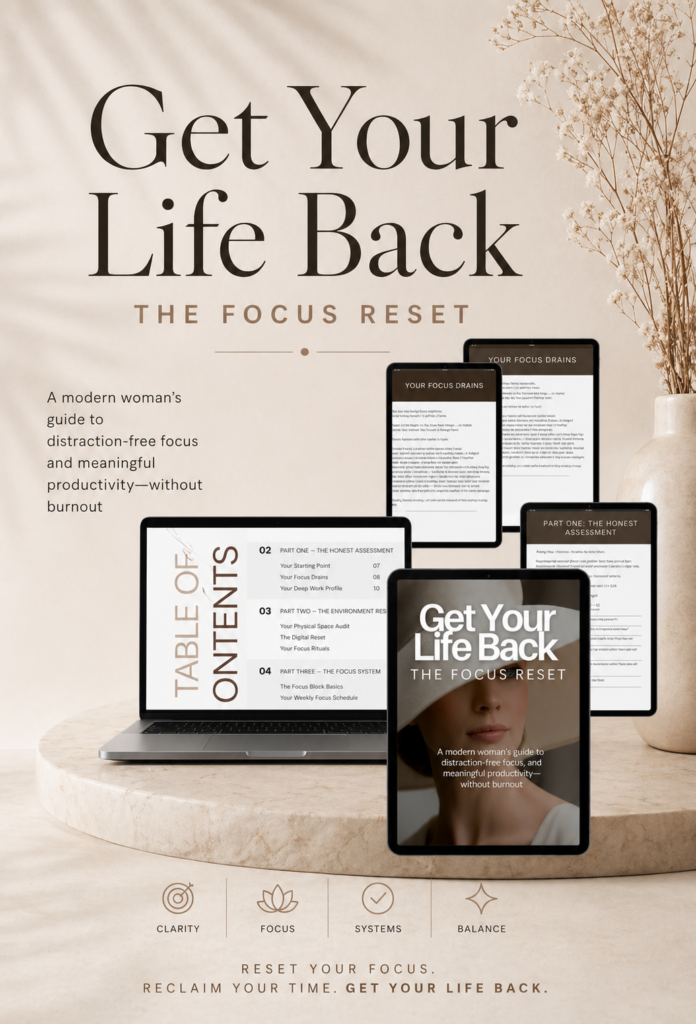
Get Your Life Back: The Focus Reset Workbook is a practical, step-by-step guide to reclaiming your attention and getting your energy pointed back in the right direction before you go all in.
The Dopamine Connection You Need to Understand
Before you dive in, there’s one more piece worth knowing. Monk mode and dopamine reset go hand in hand. When you strip away overstimulation, you reset your brain’s reward system — and suddenly, the work itself becomes satisfying again. Deep focus stops feeling like a punishment and starts feeling like a superpower.
If your attention feels completely hijacked right now, it’s worth starting here first: Launch Your Dopamine Detox Journey In 6 Easy Steps
Your Direction Has Been Waiting
Distraction is loud. It’s designed to be. Every notification, every scroll, every dopamine hit from a meaningless app is quietly pulling you further from the life you actually want to build.
Monk mode is how you take that power back.
You don’t have to disappear. You don’t have to be perfect. You just have to make a decision — one day, one season, one focused choice at a time — to stop letting the noise lead and start letting your purpose lead instead.
The version of you that is clear, driven, and deeply intentional? She hasn’t gone anywhere. She’s just been waiting for the distraction to quiet down long enough to finally step forward.
Start today. Protect tomorrow morning. Choose direction over distraction — and watch what thirty days of real focus can actually do.










14 comments
Fransic verso
This is interesting, never tried this monk mode but seems like something I would want to try. Very informative!
Lani
Hi Fransic,
I’m glad you’re willing to try “Monk Mode” Don’t forget to get your free 7 day monk mode challenge workbook.
Nisee
Wow, the Monk Mode. never heard of that but it sounds good. Thank you for sharing this and for the great tips.
Lani
Hi Nisee,
Thanks for taking the time out to read about monk mode. Do give it a try, I included a 7 day monk mode challenge workbook to help you get started.
Julie Russell
Always looking for personal growth content and this is a great article! I love your insight on ‘Monk Mode’. It sounds like an interesting method to try. I look forward to reading more articles!
Lani
Hi Julie,
I hope you try Monk mode. I included a free 7 day monk mode challenge workbook that can help you get started on this journey.
Gradiva
This sounds great, but honestly I am not ready yet to try the monk mode.
And I am not a minimalist at all, sincerely, can’t persuade myself to throw away things that I rarely use.
Lani
Hi Gravida,
I respect your decision, you might want to read my post on, 10 LIFE-CHANGING BENEFITS OF MINIMALISM FOR A SIMPLER, HAPPIER YOU.
Catherine
How interesting! I have never heard of “Monk Mode”. I thought this was really cool to learn about. I definitely need to try this out. I get distracted so easily by everything when I am working from home.
Lani
Hi Catherine,
I totally understand where you’re coming from. Take the challenge and start monk mode now. Don’t forget to claim your free 7 day monk mode challenge workbook.
eva
This sounds very enticing. I would like to try it for my next project
Lani
Hi Eva,
I’m happy that you enjoyed this post. I encourage you to give it a try. Don’t forget to claim your free 7 day monk mode challenge workbook.
Giada
Great article! I think “Monk Mode” follows the same principles of “Deep Work”. I definitely need to try it, as notifications and other distractions always gets in the way when I’m trying to write some blog posts!
Lani
Hi Giada,
Monk Mode is alternatively known as “deep work as well”. Do try it out and don’t forget to download the free 7 day Monk Mode challenge guide.